RingCentral

Case study · AI product · 0 to 1

Real-Time AI Agent Assist and Post Call Analytics

Jessica Adamson

Jessica Adamson|Lead Product Designer

I took RingCentral’s first contact center AI assistant from 0 to 1 with a lean team. Then I worked with the larger UX team behind ACE to turn what it heard on live calls into call scores, sentiment and trends.

Full visuals redacted per NDA.

Notable results

50%

less time spent on each call

35%

more problems solved on the first call

2×

as many calls handled a day

Metrics published by RingCentral on RingCX AI Assist, alongside a customer account from ClaimSolution Inc.

The challenge

Manual work and disjointed flows slowed every touchpoint.

CONTACT CENTER AGENT

“Can you hold for a moment?”

Answers to customer inquiries lived buried across company knowledge bases, notes and FAQ pages. Agents already had multiple windows open and still had to go digging while a customer waited. New hires took months to get up to speed, and turnover stayed high.

CONTACT CENTER SUPERVISOR

“Which call needs me right now?”

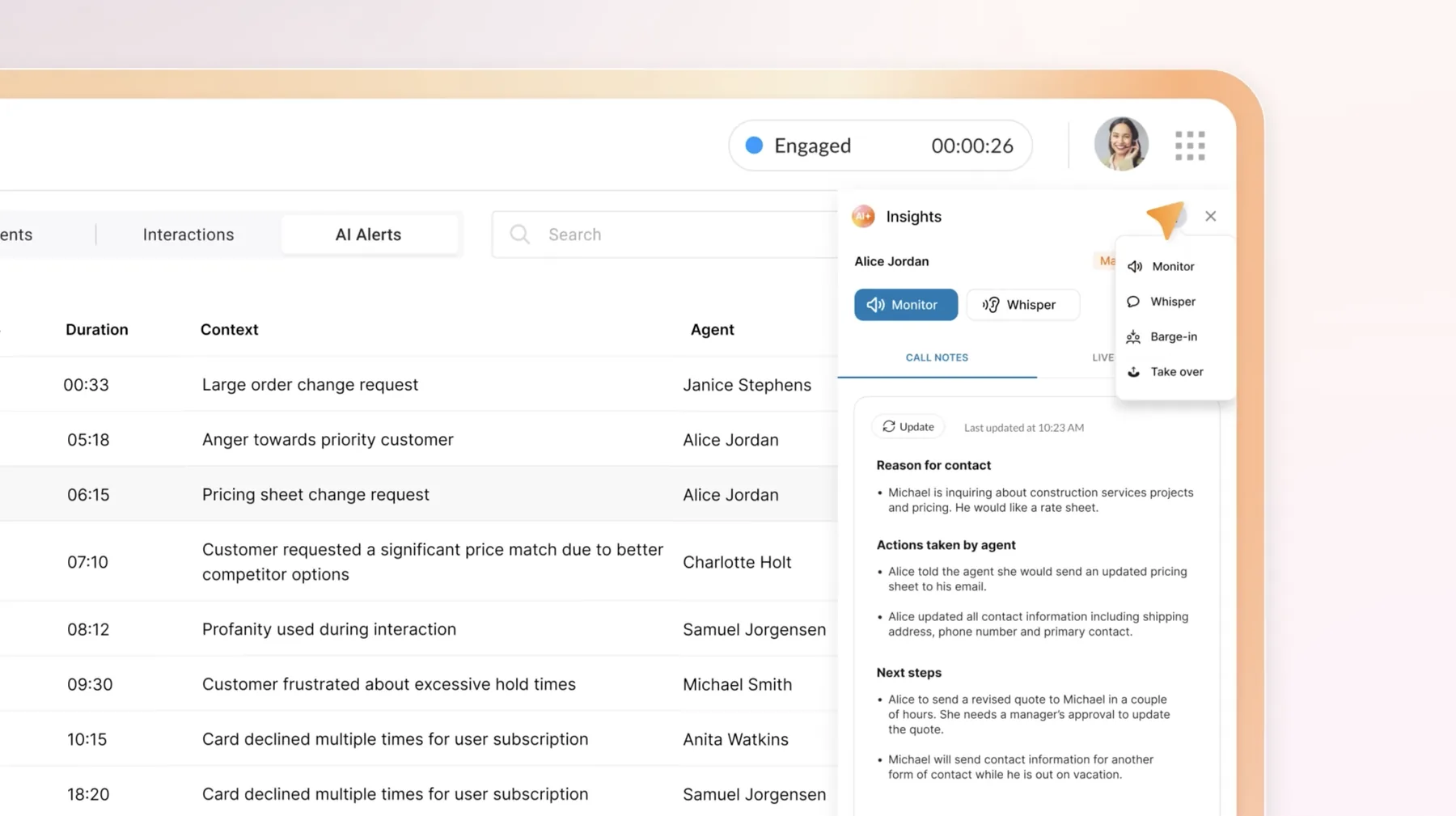
Contact center supervisors monitored dozens of live calls with no way to tell at a glance which one was going sideways. They usually found out a call had escalated after it had ended, which made coaching an afterthought instead of a save.

POST CALL

“What actually happened on these calls?”

The minute a call ended, everything that happened on it was in a transcript nobody had time to read. Supervisors referenced vague success metrics in various 3rd party tools.

OUR HYPOTHESIS

Adding an AI assistant to speed up information retrieval and surface real-time alerts will help agents serve customers more efficiently, and help supervisors know which calls to monitor.

My role

One designer on a lean, fast-moving team.

As the only designer on a lean team, I owned the design of RingCentral's initial build of Agent Assist: research, every screen and prototype, alpha and beta testing, and the go-to-market designs. When the work moved into post-call analytics, I partnered with a larger UX team to support translating AI insights into post-call coaching and reporting.

Discovery and concepts

I began by watching live recordings of customer service agents’ screens while they were on calls, and mapped their common tools and processes.

My biggest takeaway was that agents didn’t need more information - they already had 4+ windows open at once. They needed the right answer at the right moment, somewhere they could glance without losing the customer.

Supervisors had the opposite problem. They weren’t on the calls, so they were watching a dozen conversations they couldn’t hear. They didn’t need more detail either - they needed triage: which call is going wrong, why, and whether it’s worth stepping into.
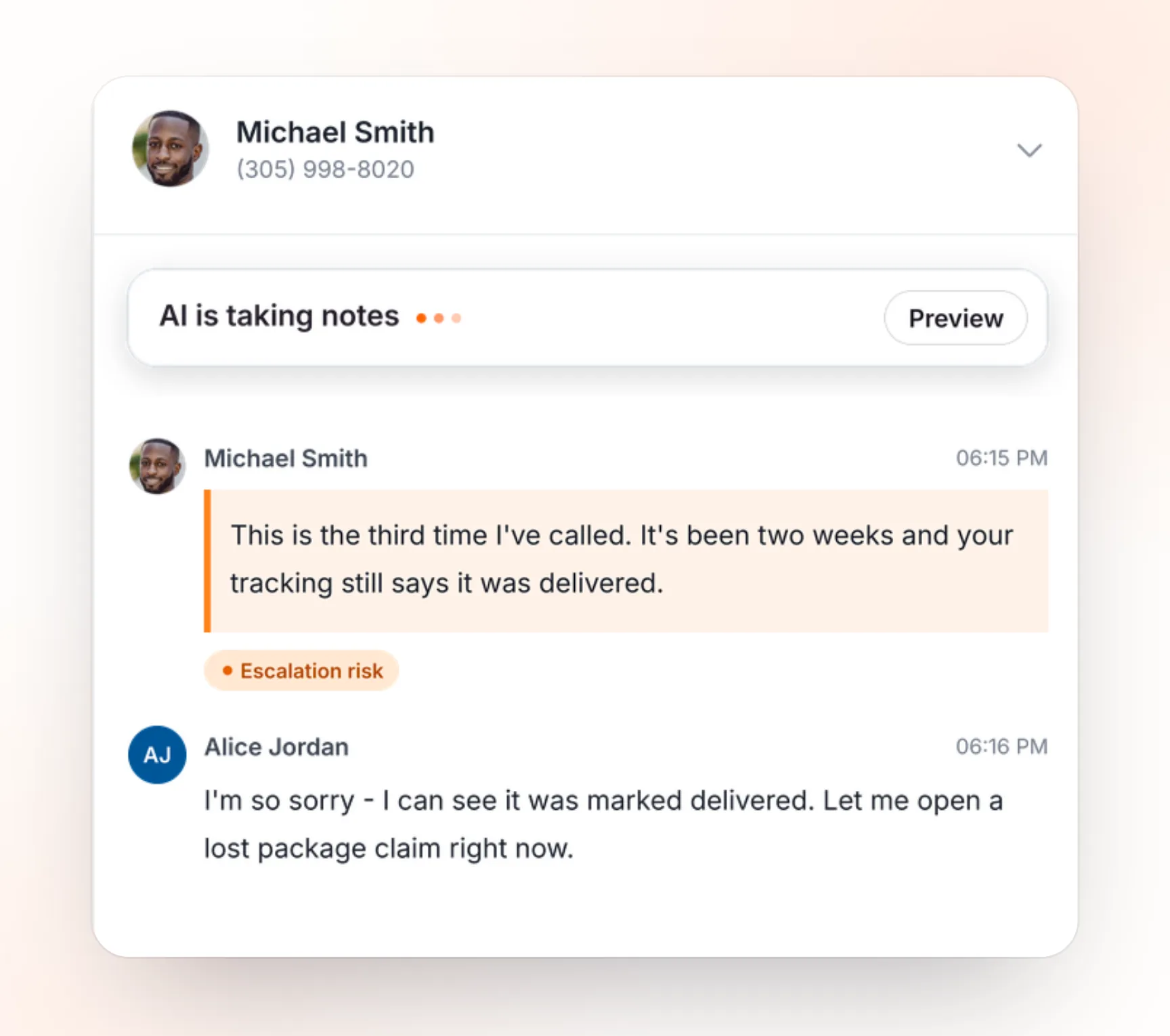
Supervisor view of a live call about a lost package: AI is taking notes, and the customer's frustrated line is highlighted and flagged as escalation risk

Stakeholder alignment

Interactive prototypes of realistic scenarios, user journey walkthroughs and outlined competitor analysis allowed our small team to get multiple stakeholders, VP and executive alignment quickly.

Designing for AI 

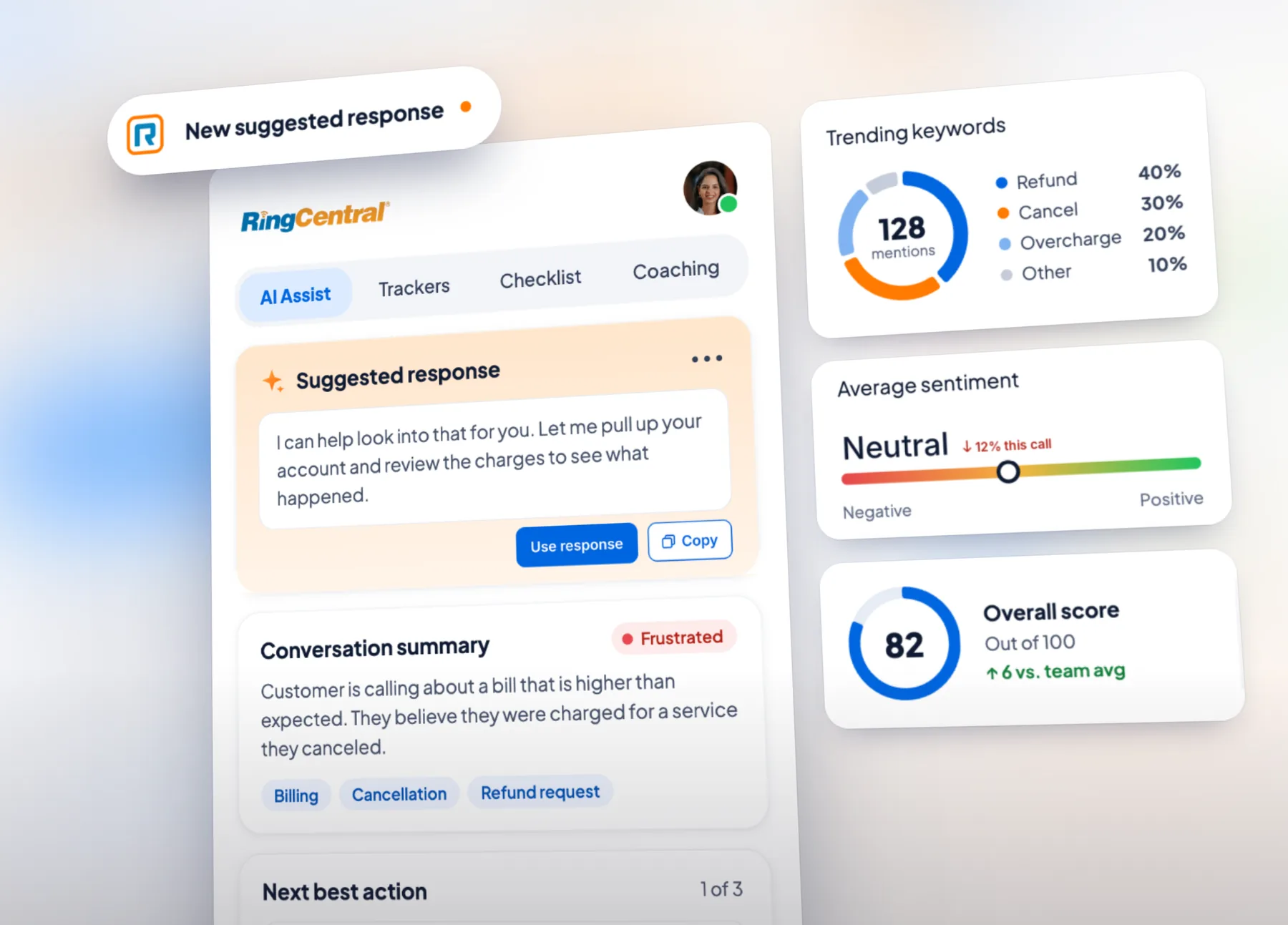
The AI Agent Assist model could listen to a call, dig through everything the company knew and hand back an answer to an agent in seconds. My job was ensuring that agent could trust the output enough to actually use it, mid-sentence, with a customer waiting.

  • Trust: every answer shows its source.
  • Wrong answers: thumbs up and down on every suggestion, plus manual ask and search as a fallback.
  • Human in the loop: suggestions inform; the agent decides what to say.
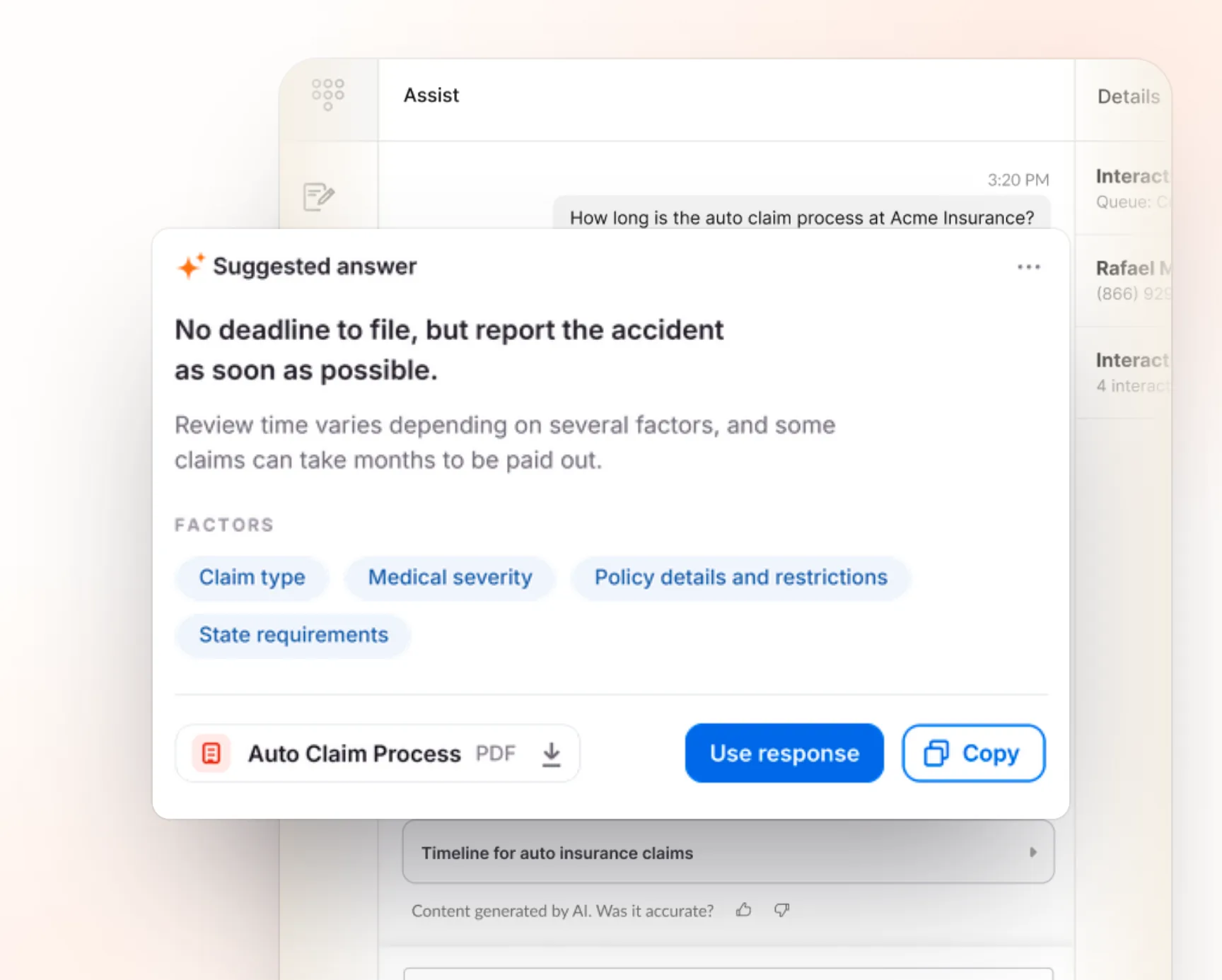
Early Agent Assist concept: the agent asks how long an auto claim takes and Assist answers from a policy PDF

Launch and go to market

RingCentral’s own support agents tested AI Assist on real calls before launch.
Two findings changed the design:

  • In the beginning, AI answers came back very lengthy, with a lot of detail. We needed to organize the information in a way that was still helpful, but not overwhelming.
  • Too many AI suggestions at once became noise.

So we restructured the answer itself, leading with the short version and keeping the full detail and its source one tap away. Then we adjusted the timing and added a tiered hierarchy, so the right suggestion appeared at the right point in the call.

Launch videoRingCX AI Agent Assist Watch on YouTube ↗

Post-call analytics, with a larger team

Everything AI Assist heard on a live call fed straight into ACE (formerly RingSense), RingCentral’s interaction analytics tool. 

Agent Assist was a lean team moving fast. ACE was a more established product with a larger UX team already in place. My job shifted from owning every pixel to being the bridge: carrying what we learned on live calls into their roadmap, and keeping the live and post-call experiences reading as one product.

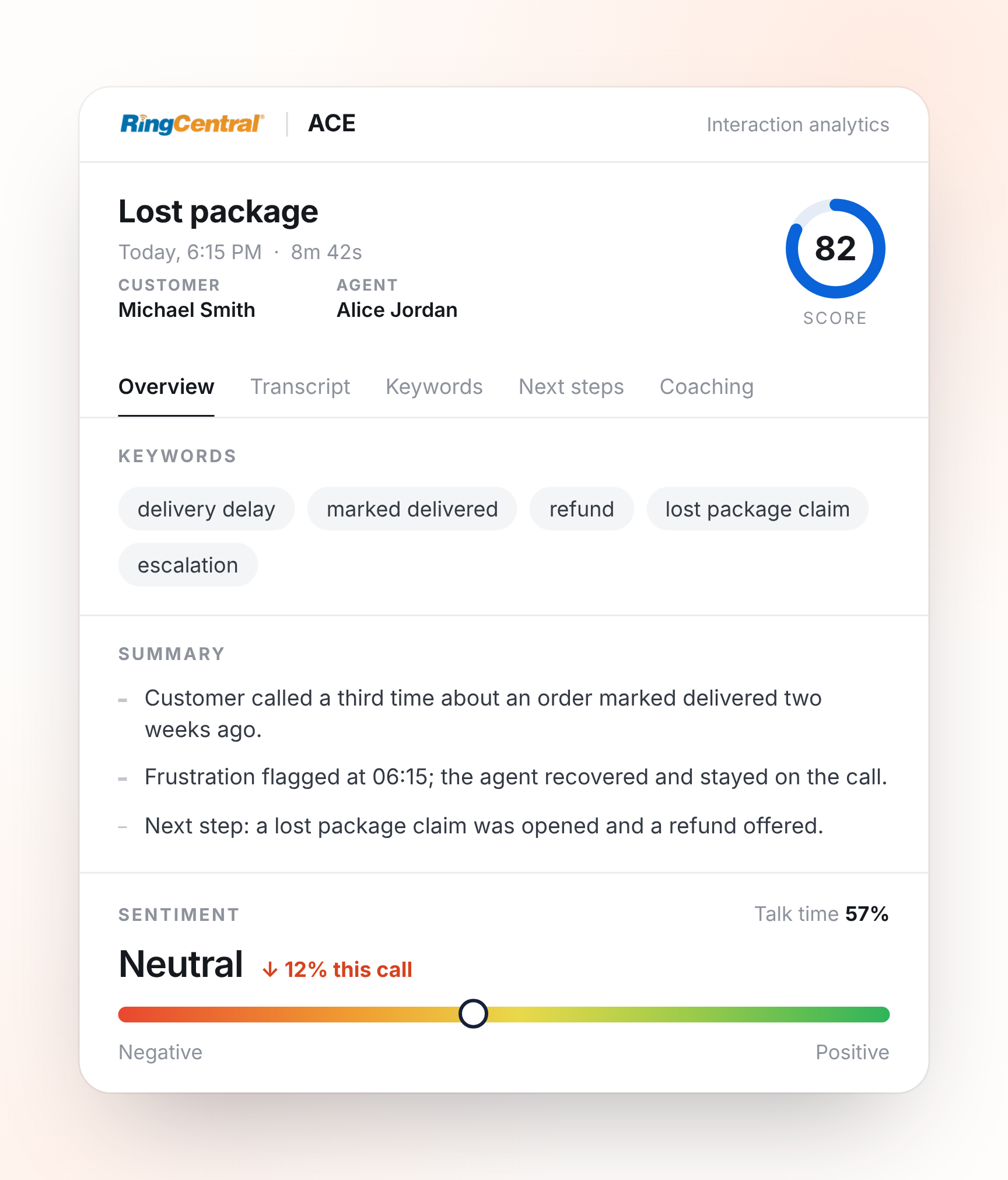
ACE interaction analytics: a call summary generated from Agent Assist signals — the call time and length, the customer and the agent, an overall score of 82, trending keywords and average sentiment

The whole contact center, caught up.

The agent

“Can you hold for a moment?” while agents dug through multiple sources of truth.

↓

Answers in the agent’s line of sight

Suggestions surface as the call unfolds, each with its source one click away - so the agent reads instead of searching.

THE NEW HIRE

New agents took months to get up to speed, and turnover stayed high because of it.

↓

Coaching built into the call

A new agent on day three has the same answers in front of them as a five-year veteran. 

The supervisor

Supervisors couldn’t tell which live calls needed them until it was already too late.

↓

Live calls, flagged as they turn

AI takes notes on every call and flags escalation risk the moment it hears it, so a supervisor knows where to step in.

POST CALL

After a call, the only record was a transcript nobody had time to read.

↓

A scored call, automatically

Every finished call arrives with a score, a sentiment read and its top keywords, built from what Agent Assist already heard.

Results

  • 20% shorter handle times in RingCentral’s own contact center
  • 10 to 20% improvement for early customers in their first weeks
  • Up to 50% lower handle time and 35% higher first-contact resolution
  • Training time cut from months to days with real-time coaching
“By cutting call handling times from 10 minutes to just 5, our agents have now doubled their daily call volume.”
Natalie Bolfeta, Office Operations Manager, ClaimSolution Inc.

Figuring out what AI means for your business? Let's talk.